Rent To Own Your Solar System
Rent-to-own solar leasing means you can pay off your solar system in fixed monthly instalments and take on full ownership at the end of the solar lease agreement
Renting your solar system means you get to spread the monthly cost, take advantage of being 'backed up' with sustainable energy, investing in a reducing electricity cost and ultimately, being smart about it.
Finance Approvals
Get your credit application approved within 12 hours
Our in-house credit department ensures that you’re able to receive a credit approval, should you qualify, at lightning speed, typically within less than a day.
Agreements In Place
Signing of the contracts. All the necessary paperwork in put in place, the terms and conditions clearly delineated. Installations are carried out ensuring that safety and regulationary standards are met.
Installation & Commissioning
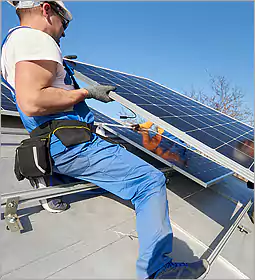
Your system is now scheduled for installation and commissioning. This usually takes 2-3 days to complete (if not sooner). Installation is caried out by our professional crew, using only the recommended fittings, connectors and cablelling, and both the workmanship and materials are guaranteed
Monthly Rental/ Payments Commence
With your solar system installation and commissioning out of the way, you are now on your sustainable energy journey. You have peace of mind that distruptions, and outages are now a thing of the past. And what a terrific feeling that is indeed. It is quite something when you can depend on yourself.
Scale or Fold Your System
Depending on your option chosen, you can opt to buy your system outright, pay faster, or add to your energy system. If you were renting, you now can return the system, buy it or upgrade to expand you.
Top Reasons to Rent
Your sustainable energy system offers your more than just peace-of-mind during load shedding (should you have opted for the battery backup system), you are investing in a system that will save you money in the future. So you are future proofing your power supply to your home or business.
The 3 Common Options to Owning A Solar System
here are three common options for financing a solar pv array – purchasing a system, solar lease, and a power purchase agreement (PPA). The main practical distinction between these approaches is in ownership.
The ultimate decision resides with you, your power situation, finances, and the urgency thereof
The house where you will install the solar system, is it owned, how long are you planning on living there, will the installation add value to your selling asset (should you sell within 3-6 years after installing), your purpose for installing a solar system in the first place - alternative power, added power, backup power, off-the-grid power independence or simply to reduce your power bill. These factors in mind will assist in determining the best way forward for you.
Purchasing a Solar System:
Paying for your system yourself is the simplest path for owning your solar system, but the initial cost of a solar panel system can be the biggest hurdle. Through a direct purchase, or “cash option”, you purchase the solar system just as you would a car or house. Typically the installation has payments due at different steps along the way - usually a down payment once you sign an agreement, a second payment when the panels are ordered, and then a final payment once the installation is complete and operational. As with any larger purchase, you can finance the payments entirely on your own, borrow money from a bank, or finance the purchase through the installer in some instances. With a direct purchase option, you will own the solar array outright - all of the electrical production, all of the “green benefits”, and any applicable incentives will be owned by you.
Solar Lease:
A Solar Lease is one of the options for “third party ownership” where the system is owned by the leasing company and typically installed with no “up front” costs. In a solar lease the customer typically pays a set monthly rate for your solar panel system, but receive free electricity from the panels that offsets the monthly cost of the lease. Solar leases are allowable in many States, however, not all jurisdictions allow solar leases.
There are two types of leases for solar energy – Capital Leases and Operating Leases. They function very differently and the customer’s financial situation, as well as State regulations, are important when choosing which one will work best for the customer.
Capital Lease
With a capital lease, the Lessee (customer) is able to capitalize on all the tax incentive and depreciation benefits that come with solar. However, the monthly payments are typically higher than an operating lease option. At the end of the lease term, the lessee has the option to buy the system from the Lessor (developer).
Operating Lease
With an operating lease, the Lessor owns the solar system and the Lessee makes a monthly payment to the Lessor. In this scenario, tax incentives and depreciation benefits go to the Lessor. This lease option is best for a customer that cannot utilize the tax benefits that come with a solar system. The Lessee can decide to purchase the solar system or renew the lease terms when the operating lease expires.
Power Purchasing Agreement (PPA)
A solar power purchase agreement (PPA) is a financial agreement where a developer arranges for the design, permitting, financing, and installation of a solar array on a customer’s property. The developer sells the power generated to the host customer – typically at a fixed rate that is lower than the local utility’s retail rate. Payments within a PPA agreement are based on the actual energy produced by the solar array every month. This lower electricity price serves to offset the customer’s purchase of electricity from the grid. The developer receives the income from the sales of the electricity as well as any tax credits and other incentives generated from the system. Customer’s entering into a PPA who wish to claim the “green attributes” of the solar energy will need to negotiate with the solar developer to retain the solar Renewable Energy Credits.
PPA’s typically range from 10 to 25 years during which time the developer remains responsible for the operation and maintenance of the system. Some PPA agreements will also offer an early “buy out” clause which enables the customer to purchase the solar array for a predetermined price or fair market value.
Similar to a solar lease., the customer typically pays nothing for the installation or maintenance of the solar system, which will be owned by the solar company. In a PPA, you pay for the electricity produced by the system directly. This electricity typically costs less than the electricity provided by your utility, so customers typically save money as soon as the array is operational.
Benefits of PPA’s for Solar Customers
No or low upfront costs: the developer is responsible for the design, procurement, installation, and inter-connection of the array with all of these “up front” costs being integrated into the terms of the 25 year PPA agreement period. Typically, this results in an agreement that saves the customer money as soon as the array is operational.
Reduced energy costs: PPA’s provide a fixed cost of electricity for the duration of the agreement. Under these agreements, a PPA typically defines a fixed annual escalation rate. Typically, the fixed escalation rate is lower than the historic escalation of utility rates, meaning that the savings per kWh under the PPA will likely increase with time.
Limited risk: the developer is responsible for the system design, procurement, installation, and all operating and maintenance through the life of the agreement.
Leveraging of incentives: Developers are typically positioned to maximize the use of available incentives like tax credits and tax depreciation value. This is particularly true for non-profit or public clients like government entities. The reduced project costs resulting from the leveraging of incentives is usually shared with the customer in the form of advantageous PPA rates.
Potential increase in property value: Studies by Berkeley Lab, The Appraisal Journal, and the National Renewable Energy Laboratory and others have indicated that solar arrays typically increase property values. Within a PPA structure, the benefits of a PPA can be transferred with the property, maintaining the attractiveness of on-site solar for future property buyers.
Which Approach is Best for You?
Purchasing a solar panel system with cash (or loan) is your best option when you
A solar lease/PPA is your best option when you ...
It is our experience that a PPA is least used as it leans in the favour of the finance house, and mostly, a lease, outright purchase (if possible) are the best.
You May Also be Interested in: